Showing posts with label algebra. Show all posts

Saturday, November 12, 2011

5.4

Hello everyone!
So as far as five four goes, it’s just building off of five three’s ideas. To start it all off, let’s review:
Last section told us that log has a subscript 10 (common log) and that ln has a subscript e (natural log). Now that we have that covered, moving onto the…

Law of Logarithms.
1) loga(uw) = logau + logaw
2)loga(u/w) = logau - logaw
3)loga(uc) = c logau
Easy enough, right? Now to le comparisons.

Common Logarithms
Natural Logarithms
log(uw) = logu + logw
ln(uw) = lnu + lnw
log(u/w) = logu – logw
ln(u/w) = lnu – lnw
log(uc) = c logu
Ln(uc) = c lnu


There are no differences in the way you play out these logarithms, just differences in the meanings.
BUT, BEWARE. THERE IS A SLIGHT CATCH. Loga(u+w) does NOT translate to logau + logaw. Also, loga(u-w) does NOT translate to logau – logaw. This isn’t like f(x) in those ways at all!


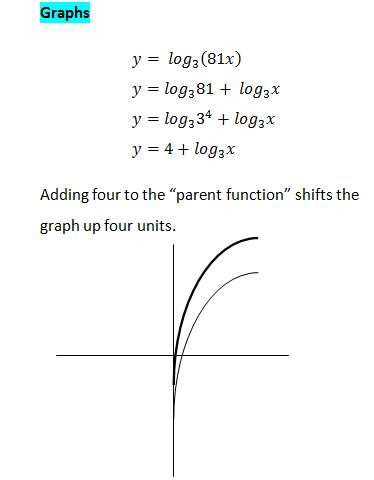
     ^ You can’t have a log of a negative number, that’s why -4 doesn’t work.

Onward again, 


So I think that’s about it, I hope this helped!
Have a great weekend!
P.s. COME TO FALL PLAY TOMORROW AT 2 PM. MR WILHELM WENT TONIGHT(sorry I didn't say hi to you) SO YOU SHOULD GO TOMORROW.

Kristy :]


Monday, October 17, 2011

3.6: Quadratic FUNctions

QUADRATIC FUNCTIONS are those funky-looking curved graphs with equations that have multiple xs and confusing exponents in them.

A function f is a QUADRATIC FUNCTION if and only if it fits in the form where a, b, and c are real numbers with a not equal to zero.

What can you figure out from a QUADRATIC FUNCTION?
a: if positive, the funtion opens up; negative, the funtion opens down
it controls the width of the graph
b: controls how the vertex moves along the inversion of the function
c: the y intercept

VERTEX: The minimum or maximum value of the function (minimum if a>0; maximum if a<0)
The coordinate of the vertex of a parabola is

AXIS OF SYMMETRY: That dotted line down the middle of the parabola that runs through the VERTEX.


on the right is the STANDARD FUNCTION
of a parabola with Vertex V(h,k)


You can make your ugly QUADRATIC EQUATION into a fashionable STANDARD EQUATION by simply completing the square, as demonstrated on the right.

Sunday, October 9, 2011

Functions


A function is relation that assigns exactly one value in the Range to each value in the Domain.

This does not mean you cannot have multiple values in the Domain assigned to one value in the Range.

The values in the domain are called elements, while the values in the range are called correspondents.


The Domain (or elements of the domain) can also be called:
  • X
  • Input
  • Independent Variable
The Range (or correspondents of the range) can also be called:
  • Y
  • Output
  • Dependent Variable
Y= f(x)

Note: Anytime you see "y-squared" it is not a function because it will have 2 x values for every y value. Also, a circle cannot be a function because it includes "y-squared".

Graphing functions can result in many different types of graphs such as:


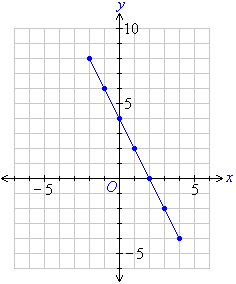
Linear Function:
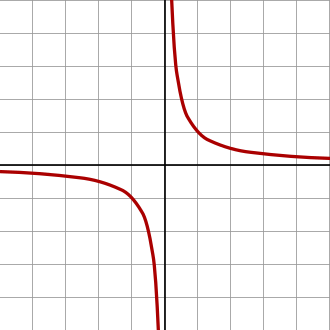
Hyperbola:
Parabola:

Trinomial:

and many others!

So... that's functions... I don't know what else to say so... yeah... I'm gonna stop typing now... and you're just gonna have to deal with it... yeah... well... YOU LOST THE GAME!

Saturday, September 10, 2011

1.2- Exponents and Radicals

Yesterday we learned about the rules of exponents. These rules are as follows:
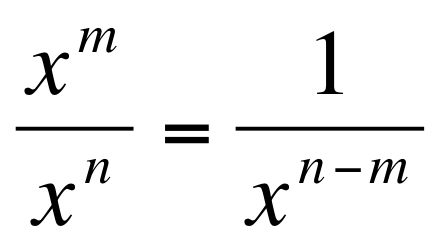
The quotient rule above is the example for when the larger exponent is in the numerator, but if the larger exponent is in the denominator you would put the base 'x' to the power of n-m all over one. That would look like this 

This next picture is an example of the work that lets you get from to , where .


We also learned how to change exponents into radicals and vice versa. But before I get into that I will go over the names of a radical's parts.
Now, I will go into making exponents into radicals, and radicals into exponents.
This shows where the exponent's numerator and denominator go when it's made into a radical.
This shows where the radical's index and the radicand's exponent go when it's made into an exponent.


The diagram below shows some examples of turning radicals into exponents:


Hope you like the post and sorry its so long.
Bye,
and Go Blue,
Alex Hackert