Showing posts with label functions. Show all posts

Wednesday, November 9, 2011

Section 5.3 - Logarithms!

This section was on logarithms! Logarithms are basically the inverse of an exponential equation. Literally, it means ratios of numbers.


exponentiation is what is being done to X in this case.


To solve, we need to undo what is being done to X, which is a logarithm :)


Mr. Wilhelm's KEY TO EVERYTHING!
That is how to rewrite an exponential function as a logarithmic function. With this, we can solve exponential equations that would otherwise be unsolvable!
This is how you might apply a logarithm to an exponential function. As you can see, Y=1,000  A=10   and X=3

The key to everything is as easy as that :)

Special Logarithms!
When it is just written "log" with no subscript, it is implied that it is log10 -- COMMON LOG!
When it is written ln, it is implied that it is loge -- NATURAL LOG!

How to graph a logarithm!
A few other little tidbits to know:
since the domain of an exponential function is (-∞, ∞), so thats the RANGE of a logarithm
the range of an exponent is (0, ∞), so thats the DOMAIN of a logarithm. (unless it has been moved by the C value)
*Exponents and Logarithms are 1 to 1*
Sorry, there are no pretty logarithm pictures on the internet :(

Links and stuff:
http://www.themathpage.com/aprecalc/logarithms.htm
http://www.sosmath.com/algebra/logs/log1/log1.html
http://www.purplemath.com/modules/logs.htm
http://www.shodor.org/unchem/math/logs/index.html
http://www.youtube.com/watch?v=mQTWzLpCcW0
And, just for old time's sake :
Nonagon Song - http://www.youtube.com/watch?v=x5ohtlewREI
One Dozen Monkeys -http://www.youtube.com/watch?v=2qdql9vsWWM&feature=related

Hope this helped and made logarithms a little less unbearable :)
Bye, Katie 

Tuesday, October 18, 2011

3.7 Operations on Functions 10/18/11

In this section, we looked at defining functions using various operations and combining multiple expressions using new methods.

First, we will take a look at the basic operations of functions: sum, difference, product, and quotient.

Sum:


---->  


Difference:

  ---->  


Caution: Remember to distribute the negative when inserting the g(x) expression.

Product:


  ---->


Quotient:


    ---->  


A sample of the sum method:


Find
Since this^^ = 
Then:


Next, we began to look into compositie functions.

The composite function   ° g  of two functions f  and g is defined by:

( ° g)(x) = f(g(x))


The domain of   ° is the set of all x in the domain such that g(x) is in the domain of f.

An example of a composite function problem:

Let  and 

( ° g)(x) 

( ° g)(x)

( ° g)(x)

( ° g)(x)

Domain problems are also common in this section, so be ready to find the domain of functions like we did in previous chapters.

Hope this helped!

-julia


Sunday, October 9, 2011

Functions


A function is relation that assigns exactly one value in the Range to each value in the Domain.

This does not mean you cannot have multiple values in the Domain assigned to one value in the Range.

The values in the domain are called elements, while the values in the range are called correspondents.


The Domain (or elements of the domain) can also be called:
  • X
  • Input
  • Independent Variable
The Range (or correspondents of the range) can also be called:
  • Y
  • Output
  • Dependent Variable
Y= f(x)

Note: Anytime you see "y-squared" it is not a function because it will have 2 x values for every y value. Also, a circle cannot be a function because it includes "y-squared".

Graphing functions can result in many different types of graphs such as:


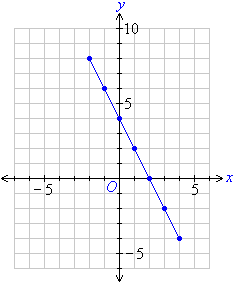
Linear Function:
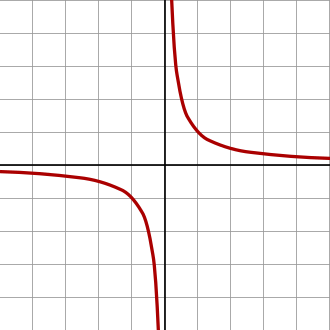
Hyperbola:
Parabola:

Trinomial:

and many others!

So... that's functions... I don't know what else to say so... yeah... I'm gonna stop typing now... and you're just gonna have to deal with it... yeah... well... YOU LOST THE GAME!