Showing posts with label graphs. Show all posts

Saturday, November 12, 2011

5.4

Hello everyone!
So as far as five four goes, it’s just building off of five three’s ideas. To start it all off, let’s review:
Last section told us that log has a subscript 10 (common log) and that ln has a subscript e (natural log). Now that we have that covered, moving onto the…

Law of Logarithms.
1) loga(uw) = logau + logaw
2)loga(u/w) = logau - logaw
3)loga(uc) = c logau
Easy enough, right? Now to le comparisons.

Common Logarithms
Natural Logarithms
log(uw) = logu + logw
ln(uw) = lnu + lnw
log(u/w) = logu – logw
ln(u/w) = lnu – lnw
log(uc) = c logu
Ln(uc) = c lnu


There are no differences in the way you play out these logarithms, just differences in the meanings.
BUT, BEWARE. THERE IS A SLIGHT CATCH. Loga(u+w) does NOT translate to logau + logaw. Also, loga(u-w) does NOT translate to logau – logaw. This isn’t like f(x) in those ways at all!


     ^ You can’t have a log of a negative number, that’s why -4 doesn’t work.

Onward again, 


So I think that’s about it, I hope this helped!
Have a great weekend!
P.s. COME TO FALL PLAY TOMORROW AT 2 PM. MR WILHELM WENT TONIGHT(sorry I didn't say hi to you) SO YOU SHOULD GO TOMORROW.

Kristy :]


Wednesday, November 9, 2011

Section 5.3 - Logarithms!

This section was on logarithms! Logarithms are basically the inverse of an exponential equation. Literally, it means ratios of numbers.


exponentiation is what is being done to X in this case.


To solve, we need to undo what is being done to X, which is a logarithm :)


Mr. Wilhelm's KEY TO EVERYTHING!
That is how to rewrite an exponential function as a logarithmic function. With this, we can solve exponential equations that would otherwise be unsolvable!
This is how you might apply a logarithm to an exponential function. As you can see, Y=1,000  A=10   and X=3

The key to everything is as easy as that :)

Special Logarithms!
When it is just written "log" with no subscript, it is implied that it is log10 -- COMMON LOG!
When it is written ln, it is implied that it is loge -- NATURAL LOG!

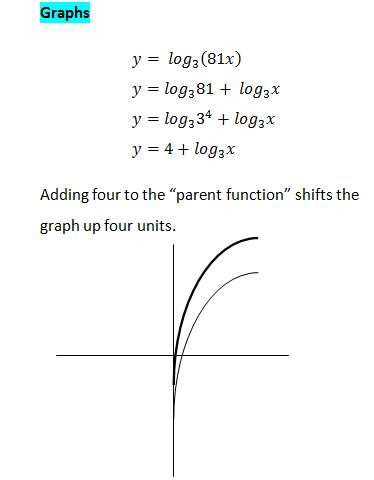
How to graph a logarithm!
A few other little tidbits to know:
since the domain of an exponential function is (-∞, ∞), so thats the RANGE of a logarithm
the range of an exponent is (0, ∞), so thats the DOMAIN of a logarithm. (unless it has been moved by the C value)
*Exponents and Logarithms are 1 to 1*
Sorry, there are no pretty logarithm pictures on the internet :(

Links and stuff:
http://www.themathpage.com/aprecalc/logarithms.htm
http://www.sosmath.com/algebra/logs/log1/log1.html
http://www.purplemath.com/modules/logs.htm
http://www.shodor.org/unchem/math/logs/index.html
http://www.youtube.com/watch?v=mQTWzLpCcW0
And, just for old time's sake :
Nonagon Song - http://www.youtube.com/watch?v=x5ohtlewREI
One Dozen Monkeys -http://www.youtube.com/watch?v=2qdql9vsWWM&feature=related

Hope this helped and made logarithms a little less unbearable :)
Bye, Katie 

Sunday, October 9, 2011

Functions


A function is relation that assigns exactly one value in the Range to each value in the Domain.

This does not mean you cannot have multiple values in the Domain assigned to one value in the Range.

The values in the domain are called elements, while the values in the range are called correspondents.


The Domain (or elements of the domain) can also be called:
  • X
  • Input
  • Independent Variable
The Range (or correspondents of the range) can also be called:
  • Y
  • Output
  • Dependent Variable
Y= f(x)

Note: Anytime you see "y-squared" it is not a function because it will have 2 x values for every y value. Also, a circle cannot be a function because it includes "y-squared".

Graphing functions can result in many different types of graphs such as:


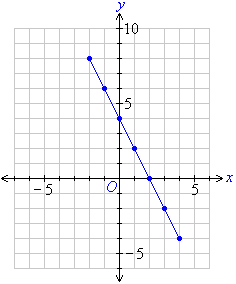
Linear Function:
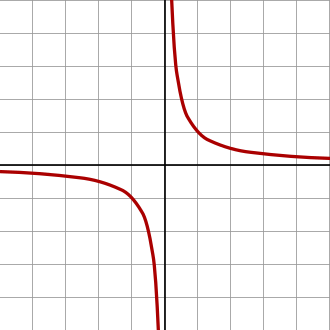
Hyperbola:
Parabola:

Trinomial:

and many others!

So... that's functions... I don't know what else to say so... yeah... I'm gonna stop typing now... and you're just gonna have to deal with it... yeah... well... YOU LOST THE GAME!

Thursday, October 6, 2011

3.1 to 3.3

Hi. The stuff covered in 3.1 to 3.3 is pretty much all things we have already learned. The first concept covered is the Cartesian Cordinate system with a x-axis, a y-axis, and four quadrants pictured below.


The next thing covered is the distance formula . The distance between any two points (x1, y1) and (x2, y2) is

The distance formula can be proved drawing a right triangle between points and finding the length of the hypothenuse using the Pythagorean Theorem as shown below.

Next we learned about the Midpoint formula. The midpoint of the line segment from (x1, y1) to  (x2, y2) is
This can be proved because the x-cordinate of the midpoint is equal to the average of the x-cordinates of the endpoints. The same goes for the y-cordinate. That's pretty much everything in 3.1.

3.2 deals with the graphs of equations. We went over some basic terminology.
     Solution: And ordered pair that yeilds a true statement
     X-intercepts: The x-cordinates of the points where a graph intersects the x-axis
     Y-intercepts: The y-cordinates of the points where a graph intersects the y-axis
You can find the x-intercept of a function by substituting the y value with 0. You can find the y-intercept by substituting the x value with 0.

The next thing covered is graphs of circles. The standard equation of a circle with center (h,k) and radius r is
Keep in mind that circles are not a function because they don't pass the vertical line test. If you want to graph a circle on your graphing calculator (which only graphs functions) you can graph two semicircles. All you have to do is solve the equation for your circle for y, which will lead you to two answers (±). For y1 enter the positive value of the equation and for y2 enter the negative value.

3.3 goes over lines

The slope of a line is defined by the formula

If the line is parallel to the y-axis, then the slope is undefined. A line parallel to the x-axis has a slope of 0.
Another important equation is the Point-Slope Form. An equation for the line through point  (x1, y1) is 
y y1 = m(x x1)
The books also talks about standard form (ax+by=c) which Mr. Wilhelm said we don't have to know.

We also went over relationships between lines.

Two nonvertical lines are parallel if and only is they have the same slope and two lines with opposite reciprical slopes are perpendicular.

Well thats pretty much everything. Bye.
     -Corn Murphy